
Moore County Projected Versus Actual
A projected date is a calculation based on the sentence and information known at the time. A Release Eligibility Date, or RED, marks when a state offender may become eligible under the governing rule. A Sentence End Date is a separate field. Neither necessarily equals the day the person will walk out of a TDOC institution.
An actual release date records a completed custody event. It can show release to parole, sentence expiration, probation, a court-ordered release, or transfer on a detainer. The event should name the releasing agency and release type. A transfer out of Moore County Jail is a local custody release, but it is not a community discharge if TDOC or another authority receives the person.
A pretrial detainee usually has no computed sentence date. Bond may authorize release, but another hold can keep the person in custody. The Moore County court record states the legal action, while the jail event states whether and when physical release processing occurred.
Find Moore County Inmate Release Dates
Start with custody, not the charge name. A short local sentence is resolved through Moore County Jail and the sentencing court. A felony sentence delivered to TDOC is checked in FOIL. The database is designed around the TDOC identity and can cover current and former felony offenders, including people connected with Moore County who are housed elsewhere.
- Identify whether the person is held pretrial, serving a Moore County sentence, or in TDOC custody.
- For a local case, request the judgment, sentence length, jail-credit entry, and any order affecting release from the court clerk.
- Ask Moore County Jail for the existing release event or the current term information it can lawfully confirm.
- For a state case, search FOIL by TDOC or State ID when known, or use the name route and compare identity fields.
- Open the detail and record Release Eligibility Date, Sentence End Date, status, Assigned Location, and the “as of” context exactly.
- Check for other sentences, detainers, corrected judgments, or parole action before treating the date as usable.
- Confirm actual release with the final agency event rather than the forecast alone.
The Moore County release-record path can help when the custodian is uncertain. Do not use a current jail roster disappearance as proof that a forecast became an actual release.
Tennessee Release Eligibility Calculations
For a TDOC sentence, RED begins with the judgment's sentence, range, offense, and offense date. Tennessee Code § 40-35-501 contains general ranges and many offense-specific rules. The general framework includes 20 or 30 percent for an especially mitigated offender as stated in the judgment, 30 percent for Range I standard, 35 percent for Range II multiple, and 45 percent for Range III persistent offenders, generally less the credits the law permits. Those figures mark eligibility rules. They do not promise parole.
Tennessee does not have one rule that makes everyone serve 85 percent. The statute applies 85-percent treatment to defined categories and date periods, including certain aggravated robbery, attempted first-degree murder, repeat drug, and listed subsection offenses. For many enumerated violent offenses committed on or after July 1, 2022, later truth-in-sentencing provisions use 100-percent treatment, with credit effects controlled by the exact subsection. The live Tennessee release eligibility statute, judgment, and offense date must be read together.
Credits can affect a computed date only as law allows. TDOC's offender handbook describes monthly behavior and program credits, possible minimum-custody credits, and one-time credits for qualifying achievements. Credits are a privilege and can be lost or withheld. Sentence Computation Services, not informal hand arithmetic, maintains the official calculation.
Note: A statutory percentage identifies an eligibility framework, not an automatic grant, fixed departure time, or end of every supervision term.
Why Moore County Dates Change
FOIL warns that dates may change when additional court documents arrive. A change is not always an error. It may reflect a corrected judgment, credit action, new sentence, or custody hold that was not part of the earlier display. Keep the date label and access time so the change can be traced.
| Factor | Possible effect | Best record |
|---|---|---|
| Jail or pretrial credit | Credits qualifying time already served | Judgment and computation |
| Concurrent or consecutive terms | Changes whether sentences overlap or run in sequence | Judgments and TDOC computation |
| Earned credit | May advance eligibility as law permits | TDOC sentence record |
| Disciplinary action | Can withhold, remove, or extend credit effects | Credit action and TDOC policy record |
| Corrected judgment | May alter the legal sentence inputs | Court order and updated computation |
| Detainer or hold | Can send the person to another custodian instead of the community | Release authorization and receiving-agency record |
| Parole action | A grant, denial, deferral, or revocation affects the release path | FOIL result and Board record |
Policy 502.01 governs sentence credit and extension actions. Policy 502.02 shows that Sentence Computation Services can extend RED after a disciplinary credit action. When FOIL conflicts with the judgment or another notice, request the sentence computation and release authorization from TDOC Records Management.
Confirm Moore County Actual Release
Use the forecast to plan a later check, not to announce release. For a state prisoner, note FOIL's exact date fields and status. VINE can send a custody-change alert, but the alert is not a certified discharge. The Moore County VINELink release check explains how to match the reporting agency and retain a confirmation.
For a Moore County Jail case, ask for the booking sheet and release screen, including admission time, release time, release reason, releasing authority, and receiving agency if recorded. Pair that event with the judgment, bond order, dismissal, probation order, or jail-credit entry. The court explains legal authority. The jail record establishes the physical event.
For TDOC, formal records can include the Release Checklist, CR-3835, and Release Authorization, CR-1947. A state release can be to parole, probation, mandatory reentry supervision, sentence expiration, or a detainer. The label must remain attached to the event.
Moore County FOIL Date Labels
The direct FOIL application offers Search By Name, Search By TDOC ID, and Search By State ID. Name search uses last name, first name, race, and an alias option, plus CAPTCHA. Identifier search is safer when a verified number is available. Open the detail rather than relying on a summary row.
Under Current Status, the exact forward-looking field is Release Eligibility Date. Sentence End Date is separate. The same panel can show Supervision Status, Assigned Location, Combined Sentence(s) Length, Supervision/Custody Level, Sentence Begin Date, Parole Hearing Date, and Parole Hearing Result. Parole or probation means community supervision, not discharge. Inactive may fit an ended TDOC relationship, but it should be checked against the date fields and formal record.
The official TDOC FOIL explanation describes the current and former felony-offender coverage.
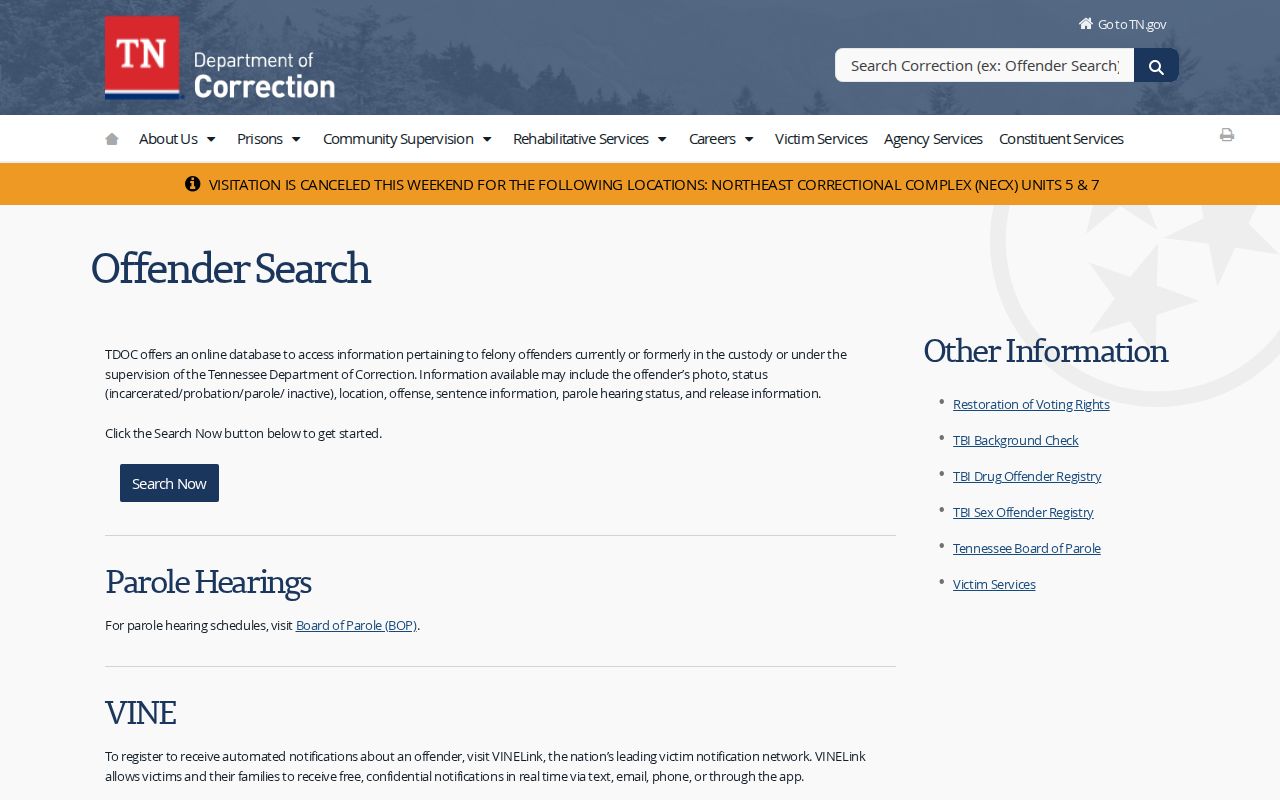
The official page shows why FOIL is suited to a Moore County state-sentence inquiry but not every short local jail stay.
Moore County Good-Time Limits
No published Moore County-specific jail good-time formula or weekend-release rule was verified. This negative finding is important. A neighboring jail's policy cannot be applied to a Moore County sentence. Ask the jail and sentencing court for the judgment, jail-credit line, concurrent or consecutive terms, any locally authorized credit record, and the actual release event.
State felony calculations use the judgment, offense date, § 40-35-501, earned and retained credits, and TDOC computation. Short county terms use local records. If jail staff gives a future date by phone, record the agency's own label and confirm it after processing. No published local rule supports moving a date solely because it falls on a weekend or holiday.
The TDOC sentence-credit policy is the source for state credit administration, not a local Moore County formula.
Moore County Custody Date Routes
Each system answers a different date question. Moore County Jail records local admission and release. The court sets the legal sentence and may grant bond or enter later orders. TDOC FOIL supplies state felony status and sentence fields. The Board controls parole decisions. BOP supplies federal release dates. ICE custody requires its own locator and agency confirmation.
| Custody | Forward-looking source | Actual event source |
|---|---|---|
| Moore County pretrial | Bond and court orders, often no set date | Jail release screen |
| Moore County sentence | Judgment, jail credit, jail calculation | Jail release event |
| TDOC felony sentence | FOIL RED and sentence computation | TDOC release authorization |
| Federal sentence | BOP projected release date | BOP released status and date |
| Immigration custody | No Moore County sentence calculation | ICE agency record |
Note: “Not at Moore County Jail” identifies no date by itself; always locate the receiving custodian before calling the event a release.
Audit Moore County Release Calculations
Preserve the record behind each date. For a state case, save the TOMIS or TDOC ID, State ID when shown, Current Status fields, RED, Sentence End Date, Parole Hearing Result, and the date checked. If FOIL later changes, the earlier capture shows which label and value were available at that time. Record a no-result search as “no result,” not “no release date.”
Ask TDOC for the sentence computation when the public fields are ambiguous. Useful named state records include the release authorization, sentence-credit action, corrected computation, and parole certificate where applicable. TDOC Release Procedures Policy 511.03 covers release types including parole, mandatory parole, probation, determinate release, sentence expiration, pardon, detainer, and court-ordered release. A detainer entry can document a custody handoff rather than a return home.
For a county case, request the docket sheet and the exact order that controls custody. The record may be a bond order, judgment, probation order, revocation order, jail-credit entry, or sentence correction. Then pair it with the Moore County Jail release event. The legal date and physical processing time may differ.
If the date came by phone, note the staff member's agency, the exact term used, and whether the figure was eligibility, expiration, or expected discharge. Ask whether another sentence or hold is part of the calculation. A verbal forecast can help direct a request, but it should not replace the source record. For electronic copies, identify the existing documents and ask for a cost estimate rather than asking staff to create a new timeline.
A parole hearing schedule also needs careful labeling. It can show that a hearing is set, not that the Board granted release. A favorable result still precedes plan approval and institutional processing. Compare the hearing result in FOIL with the later release authorization before reporting an actual date.
Never flatten separate stages into one date. Eligibility, hearing, Board result, plan approval, release authorization, physical release, supervision start, and final discharge can each happen at a different point.