
Moore County TDOC Releases
No TDOC prison is located within Moore County. A person sentenced on a Moore County felony can still leave the Moore County Jail for a state institution elsewhere in Tennessee. That transfer ends the county jail stay, but it is not a release into the community. TDOC then becomes the custodian, calculates sentence dates, keeps the institutional record, and records a later state release.
A state release can lead to parole, determinate release probation, mandatory reentry supervision, sentence expiration, or another lawful status. Each term has a distinct meaning. Parole is conditional release authorized by the Tennessee Board of Parole. Probation is supervision in the community under a sentence or release rule. An inactive FOIL status may indicate that the TDOC relationship closed, but the exact record should be read before drawing that conclusion.
| Displayed path | What it can establish | What to check next |
|---|---|---|
| Transfer from county jail | County custody ended and another custodian received the person | FOIL location and TDOC identity |
| Parole or probation | The person is outside prison under state supervision | Assigned location and District 50 |
| Inactive or expired | The displayed TDOC relationship is no longer active | Sentence dates and archived record |
| Future release field | A calculated or eligibility date, as labeled | Sentence computation and later actual event |
Search Moore County TDOC Records
The official Felony Offender Information Lookup, known as FOIL, covers people currently or formerly in TDOC custody or supervision. It is the primary public bridge from a Moore County felony case to a statewide prison or supervision record. Search by TDOC or TOMIS number when it is known. A unique agency number is safer than a name alone.
- Open the FOIL landing page and select the official search control.
- Enter the TDOC number, or use the legal first and last name.
- Review all plausible matches and compare the available identifiers.
- Open the exact record and copy each status, location, sentence, hearing, and release label as shown.
- Confirm an unclear date or status with TDOC Records Management before treating it as final.
The FOIL search form shows how the state begins a name or number search. The image below records the official entry point, not a Moore County recent-release list.
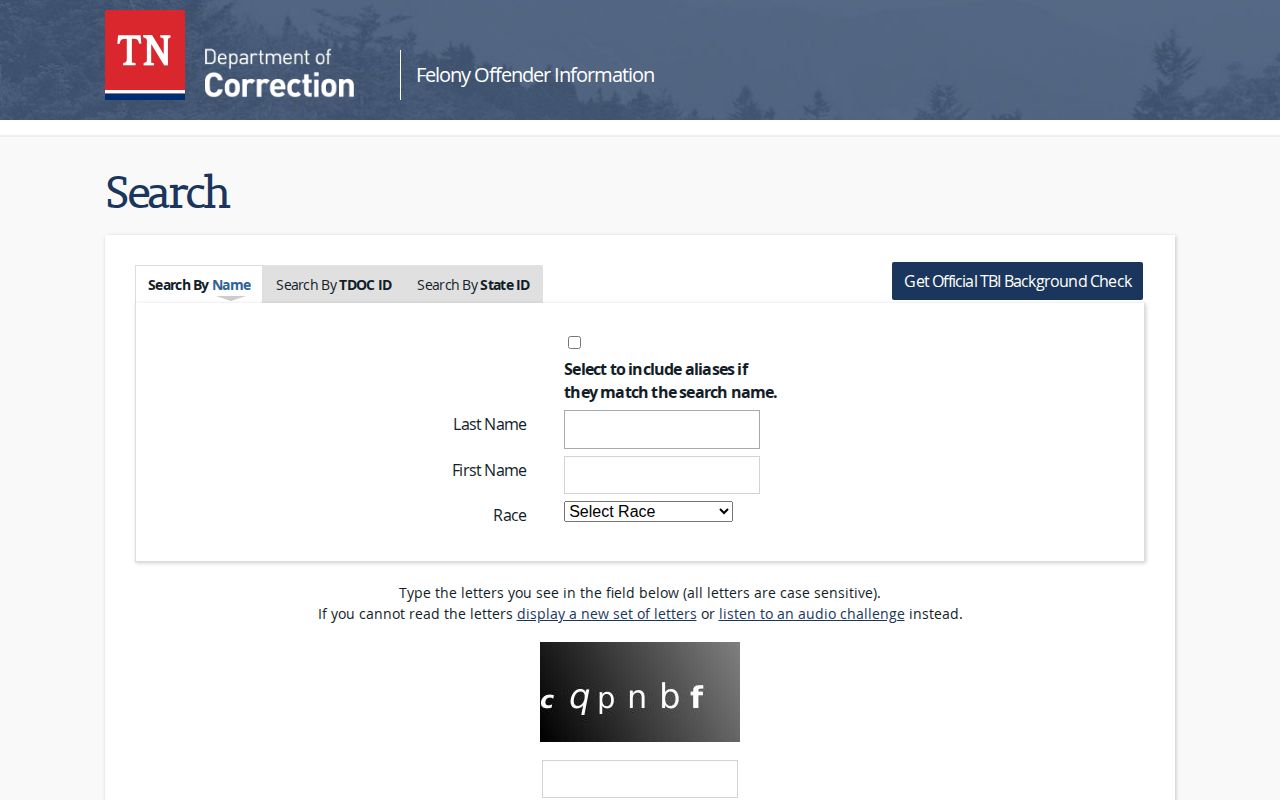
Results must be tied to the right TDOC identity and read with the live labels because field availability differs among records.
Moore County FOIL Release Fields
FOIL may display a photograph, custody or supervision status, assigned location, offense, sentence data, parole hearing result, and release information. A person on parole or probation is physically outside prison but is not necessarily finished with the sentence. “Incarcerated” points to current state custody. “Inactive” should be reported exactly, then checked against the date and sentence fields.
| FOIL item | How to use it |
|---|---|
| TDOC/TOMIS number | Distinguishes the state offender record from people with similar names |
| Current status | Separates incarceration, parole, probation, or inactive status |
| Assigned location | Identifies an institution or supervision assignment |
| Sentence and offense | Connects the record to the judgment and governing sentence |
| Release or eligibility field | Provides the date only under the label TDOC displays |
| Parole hearing result | Shows a Board stage, not necessarily the physical exit |
A future FOIL date is not proof that release occurred. Credits, discipline, new judgments, detainers, parole action, and corrections can change it.
TDOC Records for Moore Releases
Older or more detailed state records may require an archived request. The official TDOC Archived Record Request route asks for identifying information such as a full name, TOMIS number, and date of birth. A focused request can seek the release authorization, sentence computation, or archived offender record that explains the displayed status.
320 Sixth Avenue North
Nashville, TN 37243-0465
Phone: (615) 741-1000
Archived requests: TDOC.MediaRecordsRequests@tn.gov
Ask for an existing record rather than a custom explanation. If FOIL conflicts with a judgment or notification, preserve the displayed fields and request the source document that authorized the change. The agency can apply lawful exemptions and retention rules.
Moore County State Release Dates
Release eligibility, sentence expiration, and actual discharge are different events. Tenn. Code Ann. § 40-35-501 contains offense-date, classification, and offense-specific rules. Tennessee’s often cited 85-percent rule does not govern every sentence. Some covered offenders must serve at least that share, less only credits allowed by law, while other convictions follow different rules or have no release eligibility.
- Release eligibility
- The point at which a governing rule may allow consideration for release.
- Projected date
- A forward-looking calculation that can change before the event.
- Sentence expiration
- The end point of the sentence calculation, subject to the actual record.
- Discharge
- The recorded end of the custody or supervision relationship identified by the agency.
TDOC Policy 502.01 governs sentence credit and extension actions. Policy 502.02 addresses disciplinary credits and shows that Sentence Computation Services can extend a release eligibility date after a disciplinary action. Hand calculations from a charge label omit too much. The judgment, jail credit, consecutive or concurrent structure, detainers, and TDOC computation belong together.
Supervision After Moore County Release
A person released from a Tennessee prison may report to TDOC Community Supervision. Moore County is geographically served by District 50 in Tullahoma, which also covers Coffee, Franklin, and Lincoln Counties. FOIL’s Assigned Location should be checked before using that office as proof of an individual assignment.
703 Lakeway Place
Tullahoma, TN 37388
Phone: (931) 454-1915
Fax: (931) 454-1917
The Tennessee Board of Parole makes parole decisions, while TDOC handles field supervision. A hearing date, recommendation, grant, approved release plan, institutional exit, and end of supervision can occur at separate times. The dedicated Moore County parole and probation page explains how to verify those stages without equating them.
Moore County Jail or TDOC
FOIL is not a universal Moore County Jail archive. A misdemeanor detainee, a person released before a state felony commitment, or someone never supervised by TDOC may have no FOIL record. In that situation, the Moore County Sheriff’s booking and release event plus the trial-court docket are the correct sources.
Conversely, a Moore County case can produce a TDOC record even though the person was housed in another part of Tennessee. The database follows the TDOC identity, not county residence. If the jail event says “transfer,” the receiving agency should be followed. If it says bond, the Moore County case usually continues unless a later court order disposes of it.
Note: Record “no result” as a search outcome, not as proof that a person was never held or has been released.
About Tennessee State Custody
The Tennessee Department of Correction is a statewide prison system, not a detention facility inside Moore County. Its records can explain what happened after a county felony sentence entered state custody. FOIL provides the public starting point, the Board of Parole supplies decision information, and archived records can document older sentence and release actions.
The Moore County release path therefore depends on the custodian at each stage. A county jail event proves the local movement. A TDOC record proves the state episode. A later federal or immigration hold requires the federal system’s record. Keeping those episodes separate prevents a transfer out of one agency from being mislabeled as unrestricted release.
Moore State Release Audit Trail
A careful state-release check preserves what was searched and what the public system actually returned. Record the legal name entered, the TDOC or TOMIS number, the date and time of access, the source URL, and each status or date exactly as labeled. If a name search produces several possible records, keep the identifiers used to exclude the others. That small audit trail helps prevent a later FOIL update from being confused with the result seen on the original date.
For a Moore County case, pair the FOIL record with the originating judgment. The judgment can show the sentence, offense date, jail credit, and whether terms run at the same time or one after another. FOIL can show TDOC’s current public calculation and supervision status. Neither source alone should be forced to answer the other agency’s question. If the dates conflict, ask TDOC for the sentence computation and release authorization instead of choosing the more convenient value.
Parole records need a separate sequence. Note eligibility, the scheduled hearing, the FOIL Parole Hearing Result, Board disposition, release-plan approval, certificate or authorization, the institutional exit, and the later end of supervision. A grant can precede release processing, and the person may remain confined until every required step and hold is resolved. For a sentence expiration path, preserve the expiration label and confirm the actual discharge event. This approach produces a Moore County state custody history without inventing a single universal “release date” that the official records do not use.